
Your boiler has been loyal for 20 years. It fires when you need it, heats the house, and you've never had to think much about it. It also wastes roughly one out of every five dollars you spend on heat — and has been doing that the entire time.
That's not a knock on old equipment. It's just how standard boilers work. And if you're at the point where you're looking at a replacement, it's worth understanding what you're actually choosing between.
AFUE: the one number that matters
AFUE stands for Annual Fuel Utilization Efficiency. It measures how much of the fuel you burn actually becomes useful heat in your home, versus what goes out the flue as waste.
A standard boiler runs at 80% AFUE. That means for every dollar you spend on fuel, 80 cents heats your house and 20 cents goes up the chimney.
A high-efficiency condensing boiler runs at 95% AFUE or better. Same dollar, 95 cents of heat.
The math on that difference is bigger than it looks. You're not just gaining 15 percentage points — you're eliminating 75% of the waste. The real efficiency gain relative to what you were burning is closer to 19%.
Said plainly: same heat output, about 16% less fuel.
How a modulating boiler actually works
Here's something most people don't know about a standard boiler: it has two speeds. On and off.
When the thermostat calls for heat, it fires at full capacity. When it hits setpoint, it shuts down. Then it fires again. Then shuts down. All day, every day — regardless of whether you need a little heat or a lot.
Think of it like driving with only two options: full throttle or coasting. You'd burn a lot more fuel than you need to.
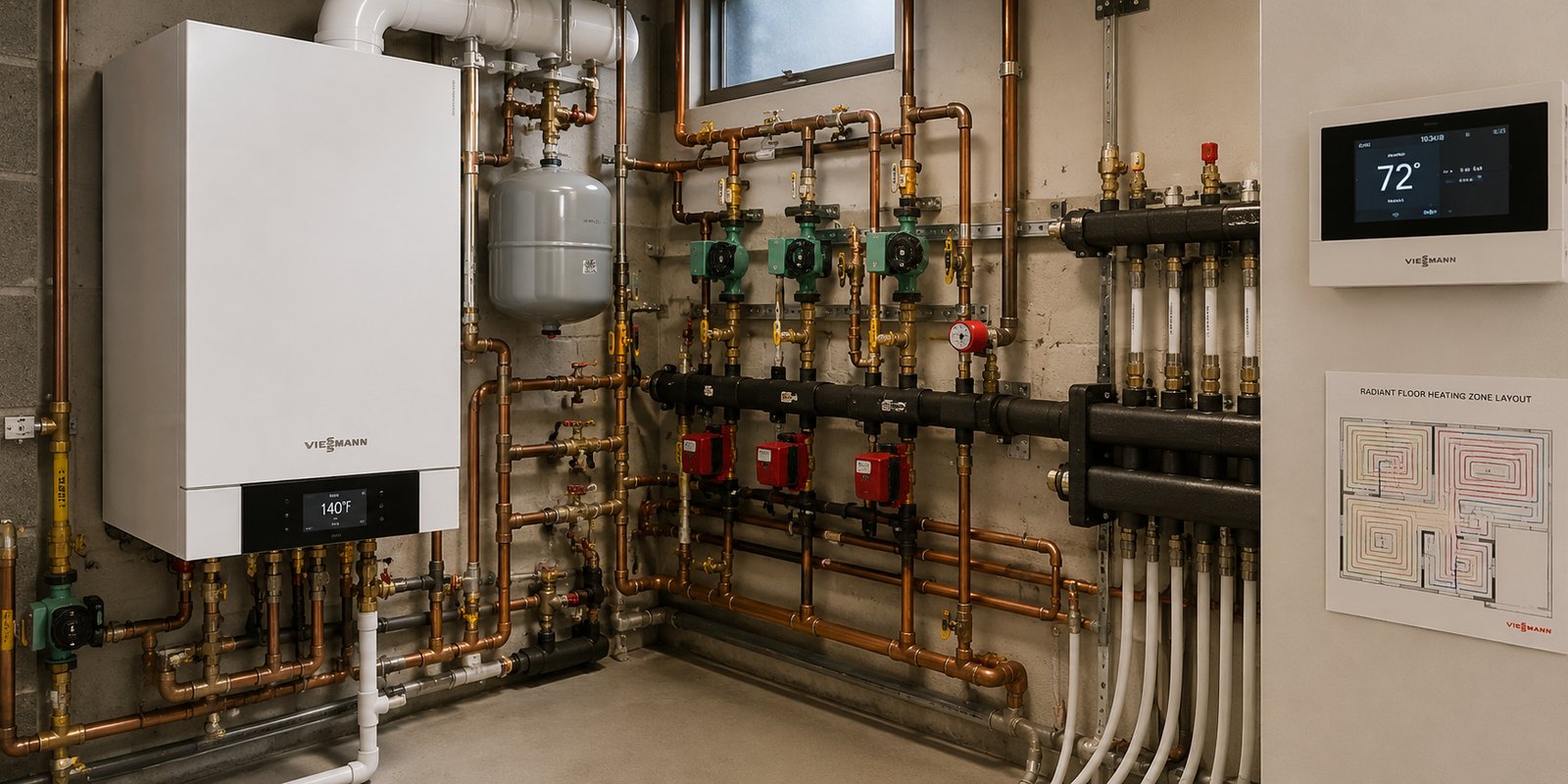
The Viessmann condensing boilers we install are modulating units. They read what the house actually needs and produce exactly that — lightly stepping on the accelerator instead of flooring it. On a mild fall day when you need 30% capacity, that's all they use. On a January night at -10°, they ramp up to meet the load. The burner output adjusts continuously across a wide range rather than cycling on and off at full blast.
This does two things: it keeps the home at a more consistent temperature, and it burns significantly less fuel over the course of a season than a single-stage unit of the same rated capacity would.
What that costs you in northern Michigan — right now
Fuel pricing used in this post:
- Natural gas: $1.09/therm (Michigan residential average, EIA data, 2025/26 heating season)
- Propane: $2.37/gallon (Michigan residential average, EIA week ending March 30, 2026)
Base assumption: a typical northern Michigan home using the equivalent of 1,200 therms per heating season. That's a reasonable middle estimate for a well-insulated home of 1,500–2,200 sq ft running through a real northern Michigan winter.
Natural gas:
80% AFUE — 1,500 therms needed, $1,635/year 95% AFUE — 1,263 therms needed, $1,376/year Annual savings: $259
Propane (at ~91,500 BTU/gallon):
80% AFUE — 1,463 gallons, $3,467/year 95% AFUE — 1,232 gallons, $2,920/year Annual savings: $547
The LP number is the one that gets people's attention. When fuel costs more per BTU, efficiency gains compound harder. A 16% reduction in fuel use hits very differently at $2.37/gallon than it does at $1.09/therm.
Combi boilers: ditch the water heater too
A standard boiler heats your home. A combi boiler — short for combination boiler — heats your home and produces your domestic hot water from a single unit, eliminating the need for a separate tank water heater entirely.
Here's why that matters.
A traditional tank water heater keeps 40 to 80 gallons of water hot around the clock, whether you're using it or not. That standby heat loss adds up to real money over a year. A combi boiler produces hot water on demand — when you open a tap, it heats water as it flows through, then returns to standby when you're done. No tank sitting in the basement losing heat all day.
For a home that already needs a boiler replacement, a combi setup is worth serious consideration. You're consolidating two aging pieces of equipment into one high-efficiency unit, freeing up space, eliminating one more thing that can fail, and cutting standby losses out of your energy bill entirely.
The Viessmann Vitodens line — which we install across Oscoda, Montmorency, Ogemaw, and Alcona counties — includes combi configurations that handle both space heating and domestic hot water at the same high efficiency rating. For in-floor radiant heat systems especially, a Viessmann combi is a particularly clean solution: one unit managing low-temperature hydronic heat through the floor and instant hot water at the tap, all at 95%+ AFUE.
What actually changes on the install
Venting. A condensing boiler runs cool enough that the exhaust can go through PVC pipe instead of metal B-vent. PVC is cheaper, easier to work with, and doesn't require a masonry chimney. In most cases the venting change is a wash or a savings, not an added cost.
Condensate drain. Because a condensing boiler extracts so much heat from the exhaust gases, water condenses out — typically a gallon or two per hour of operation. That water has to go somewhere. A condensate drain line is required, and if it's draining into a metal trap or older cast iron, a neutralizer is needed to bring the pH up first. It's a small inline device — not a big deal — but it has to be part of the install.
Return water temperature. Condensing boilers do their best work when the return water is cool — below 130°F. In-floor radiant systems and low-temp baseboard systems get the most efficiency benefit. This doesn't disqualify high-temp systems from upgrading, but it's worth knowing.
Gas line sizing. Some older gas lines are sized tight. Worth checking the line against the new unit's input rating before finalizing the quote, especially if you're changing capacity at the same time.
None of these are deal-breakers. They're just things to account for upfront.
The payback period
A condensing boiler costs more upfront than a standard replacement. A fair mid-range figure for the premium is around $1,500–$2,500. Using $2,000 as the baseline:
Natural gas: $259/year savings — payback in 7.7 years Propane: $547/year savings — payback in 3.7 years
A quality condensing boiler has a service life of 20–25 years. For an LP customer, that's a 3.7-year payback on equipment that runs another 20 — over $10,000 in fuel savings over the life of the boiler before accounting for any fuel price increases. For natural gas customers, under 8 years to break even on 20+ years of equipment is a sound investment by any measure.
Who should upgrade now versus wait
You're on propane and your boiler is 12+ years old. Don't wait for it to fail. The payback period is short enough that every year you run that old unit is real money left behind. Plan a replacement on your schedule, not the boiler's.
You're on natural gas and your boiler is 15+ years old. Same logic. When you're past the midpoint of expected service life, the question isn't whether it'll need replacing — it's whether you want to control the timing.
Your boiler is under 10 years old and running fine. Probably not worth the swap for savings alone. Run it out, keep it maintained, and make the condensing decision when you're actually at a replacement.
You're already replacing it for any reason. There's almost no argument for going standard 80% at that point. You're already paying for labor and installation. The incremental cost of going condensing is at its smallest, and the long-term savings are the same either way.
Fuel pricing sources: Michigan residential propane price, EIA weekly survey, week ending March 30, 2026 ($2.37/gal). Michigan residential natural gas price, EIA annual residential data, 2025 heating season ($10.92/Mcf, converted to $1.09/therm). Both figures represent statewide residential averages — your actual price will vary by supplier, location, and contract terms.