
What Should Be in an HVAC Estimate — and What Should Be a Red Flag?
Getting quotes for a new heating or cooling system is one of those things that sounds straightforward until you're actually doing it. You have two or three estimates in front of you, the prices are different, and it's not always obvious why — or which one you should trust.
A good HVAC estimate isn't just a number. It's a document that tells you exactly what you're getting, who's doing the work, and what happens if something goes wrong. Here's what to look for — and what should give you pause.
The Equipment Should Be Spelled Out Specifically
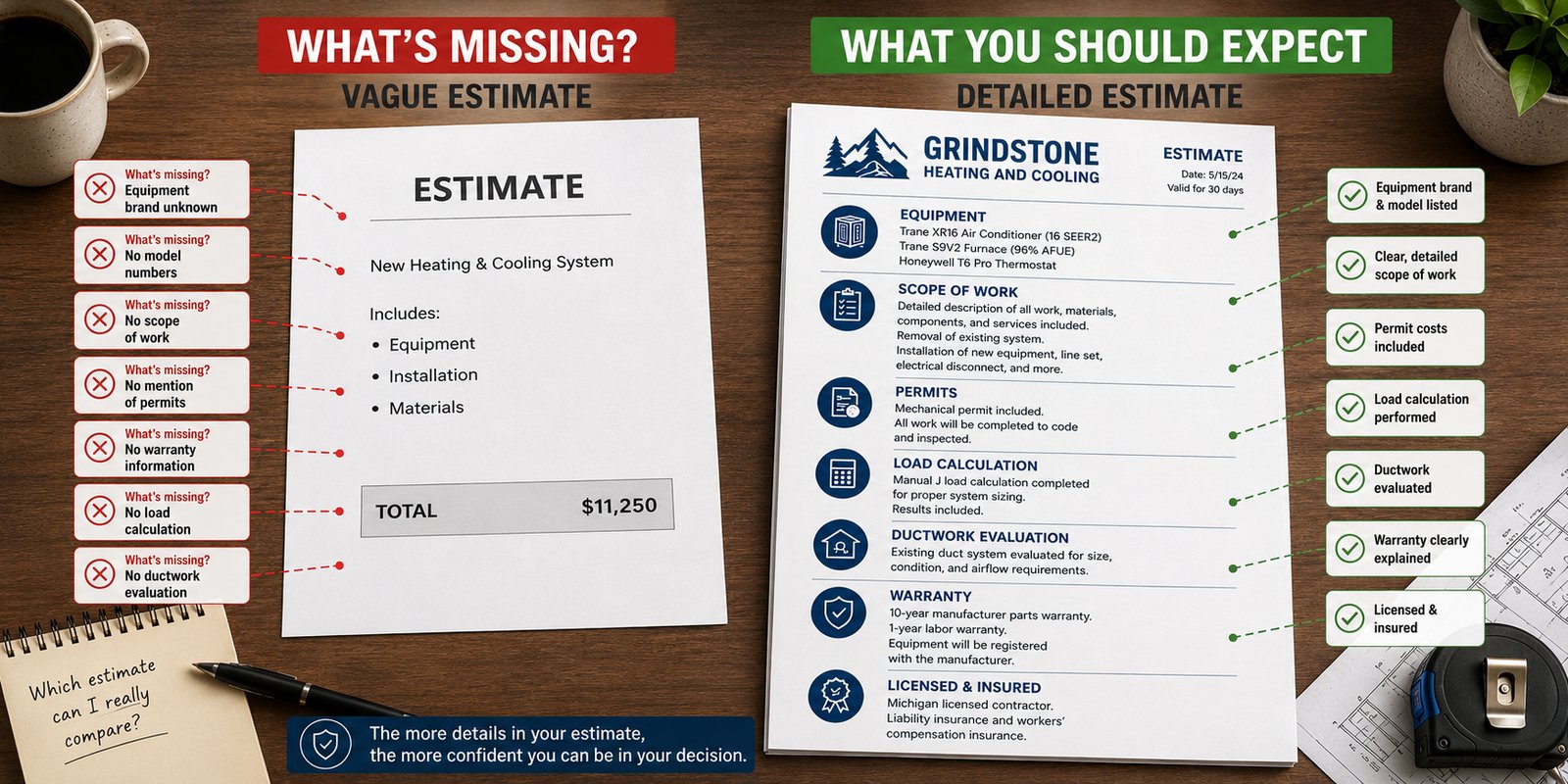
A legitimate estimate names the equipment. Not just a category like "high-efficiency heat pump" or "two-stage furnace" — the actual brand and efficiency rating.
This lets you compare quotes accurately. If one contractor is pricing a Mitsubishi or LG system and another is pricing a brand you've never heard of, those are not equivalent bids even if the installation cost looks similar.
What to look for: Brand name, efficiency rating (SEER2 for cooling, HSPF2 for heat pumps, AFUE for furnaces), and capacity.
Red flag: "Quality equipment" or "high-efficiency unit" with no manufacturer named.
The Scope of Work Should Leave No Room for Interpretation
What exactly is being installed, removed, and included? This is where vague estimates create expensive surprises.
A complete scope of work should spell out what's being removed, what's being installed, and every component that goes with it — line sets, electrical disconnect, pad or mounting hardware, thermostat, and any additional materials specific to your installation. On replacement jobs, ductwork should also be part of the conversation — existing duct systems need to be evaluated to confirm they're properly sized and can meet the airflow requirements of the new equipment. A new system installed on undersized or poorly configured ductwork won't perform the way it should.
We've seen situations where a homeowner assumed "installation" included a new thermostat, new refrigerant line sets, or haul-away of the old unit — and none of those were in the actual contract. The miscommunication was honest, but it still cost money to resolve.
What to look for: A description of every component being installed and every task being performed, including whether existing ductwork will be assessed.
Red flag: "Install new system" with no further detail. That sentence covers almost nothing.
System Sizing Should Be Based on a Load Calculation, Not a Guess
One of the most consequential decisions in any HVAC installation is how big the system should be. Too large and it short-cycles — turning on and off too frequently to properly dehumidify your home or maintain even temperatures. Too small and it runs constantly without keeping up.
The right way to size a system is with a Manual J load calculation — an engineering-based process that accounts for your home's square footage, ceiling height, insulation, windows, local climate, and more. It produces a specific number: exactly how much heating and cooling your home actually needs.
The wrong way is to size by a rule of thumb, match whatever was there before, or make a judgment call without doing the math.
What to look for: A contractor who mentions Manual J, asks detailed questions about your home, or provides documentation of the calculation.
Red flag: A system size determined without any questions about your home's insulation, layout, window count, or construction — or a contractor who just matches the size of what's being replaced without explaining why.
Permits Should Be Part of the Plan
In Michigan, HVAC installations require mechanical permits. Pulling a permit means the work is inspected by the local authority and confirmed to meet code. It also protects you — unpermitted work can create problems when you sell your home or file an insurance claim.
A contractor who skips permits is either unaware of the requirement or trying to avoid the scrutiny that comes with inspection. Neither is a good sign.
What to look for: An estimate or contract that includes permit costs as a line item, or a contractor who proactively mentions the permit process.
Red flag: No mention of permits, or a contractor who suggests permits aren't necessary or can be skipped to save money.
Grindstone pulls permits on every installation. It adds a step to the process, but it means the work is done right and documented.
The Warranty Should Be Clearly Defined
Most HVAC equipment comes with a manufacturer's warranty — but that warranty typically only covers parts, not labor. And in many cases, it only applies if the equipment is registered after installation and installed by a licensed contractor.
Labor warranties are separate and vary by contractor. Some offer one year, some offer more, some offer nothing in writing at all.
If the estimate or contract doesn't spell out both the equipment warranty and the labor warranty, you don't actually know what you're covered for.
What to look for: Equipment warranty length and terms, labor warranty length, and confirmation that equipment will be registered with the manufacturer.
Red flag: A verbal warranty promise with nothing in writing, or an estimate that doesn't address warranty at all.
The Contractor Should Be Licensed and Insured
Anyone doing HVAC work in Michigan should hold a valid state contractor's license and carry liability insurance and workers' compensation coverage.
Licensing means the contractor has demonstrated a baseline of competency and is accountable to a licensing board. Insurance means that if something goes wrong — property damage, an injury on the job — you're not the one holding the bill.
What to look for: A contractor who can provide their license number and proof of insurance on request, without hesitation.
Red flag: Vague answers about licensing, reluctance to provide documentation, or a significantly lower price that's hard to explain — unlicensed contractors often undercut the market because they're cutting out the overhead that legitimate businesses carry.
A Good Contractor Doesn't Need to Rush You
Same-day pricing pressure — "this price is only good today" or "I have another job in your area and can start tomorrow if you sign now" — is a sales tactic, not a reflection of reality. Reputable HVAC contractors are busy, but they're not so desperate for your signature that they need it in the next hour.
A legitimate estimate should give you time to read it, compare it to other quotes, and ask follow-up questions. If a contractor makes you feel like taking time to think is a mistake, that's information worth paying attention to.
Red flag: Any artificial urgency around signing, or pressure that makes it feel risky to take a day to think things over.
The Bottom Line
Price matters — but it's only one part of what an estimate tells you. A detailed, specific estimate from a licensed, insured contractor who can explain their sizing process and stand behind their work in writing is worth more than a low number on a vague one-page quote.
The homeowners who call us with the worst stories usually picked the cheapest bid. The second-cheapest usually wasn't far behind in price — but it came with a lot more documentation.
Grindstone serves Oscoda, Crawford, Ogemaw, Montmorency, Alcona, and Alpena counties. If you're comparing estimates and want a second opinion on what you're looking at, give us a call. We're happy to walk you through it.