
Wildfire Smoke Keeps Reaching Northern Michigan — Here's What the Research Says About Protecting the Air Inside Your Home
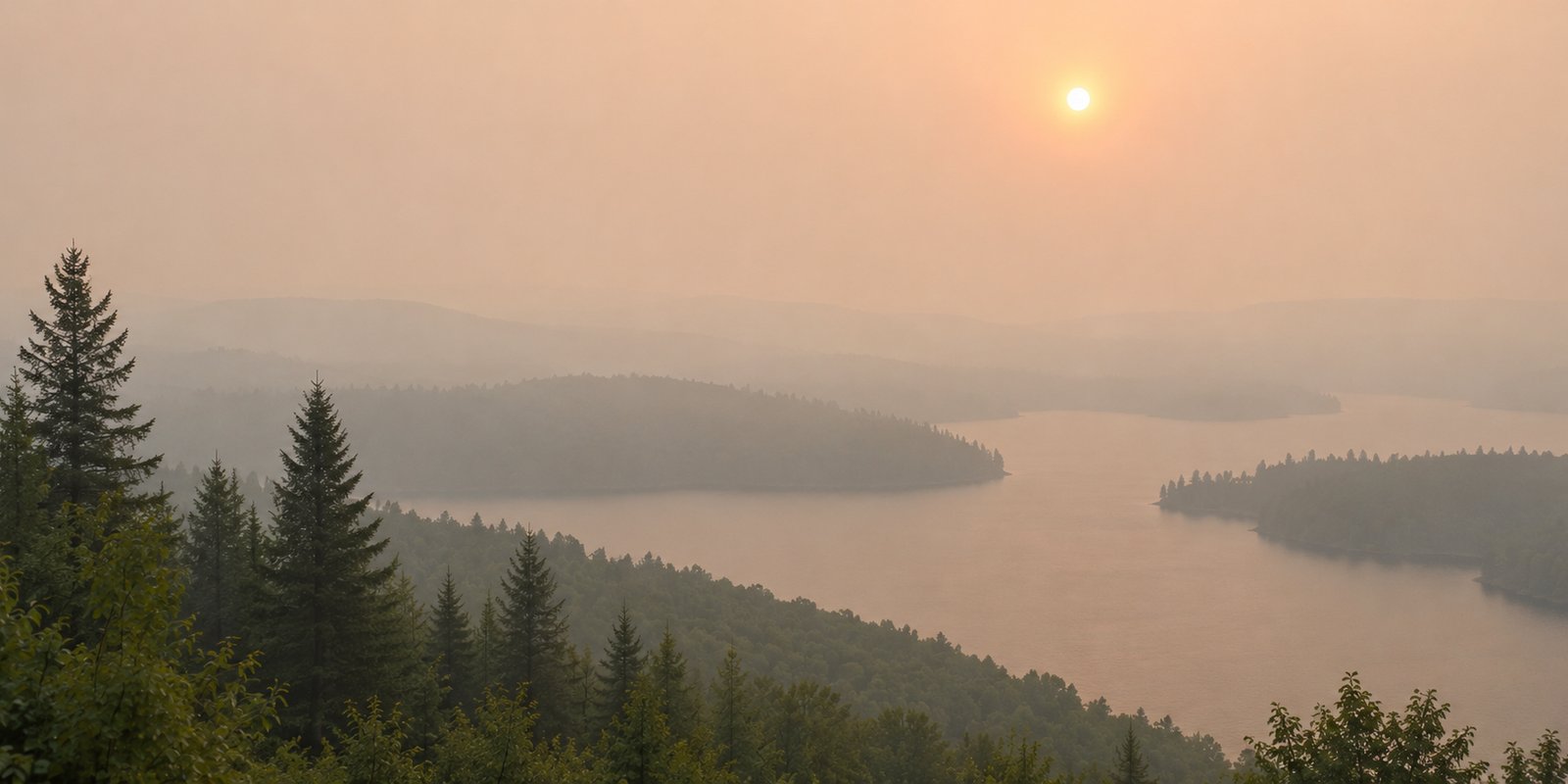
Canadian wildfire smoke has become a recurring visitor to northern Michigan's summers. When it rolls in, the sky turns hazy, the air smells like a campfire, and local air quality alerts go out. It's easy to treat that as a temporary inconvenience — something to wait out until the wind shifts. But there's a growing body of research on what wildfire smoke actually does to the air you breathe, and it points to something worth taking seriously: most of the exposure that matters happens indoors, in the hours and days after the smoke arrives, not just outside during the haziest afternoon.
Here's what the science says, and what it actually means for your home's HVAC system.
The Real Concern Is a Particle You Can't See
Wildfire smoke looks like haze, but the health risk isn't really the haze — it's PM2.5, fine particulate matter smaller than 2.5 microns across. During a wildfire, particle concentrations in the air can rise quickly, ranging from a light haze to a serious reduction in visibility, and much of that particulate falls into the PM2.5 size range. These particles are small enough to bypass the body's natural filtering — the nose and upper airway — and travel deep into the lungs.
Wildfire smoke contains PM2.5 that leads to a range of health effects that decades of research on ambient PM2.5 exposure have already established. What's more concerning is that wildfire-specific PM2.5 doesn't appear to behave exactly like the particulate from everyday sources such as traffic. A 2021 analysis in Nature Communications found that respiratory hospitalizations rose by roughly 1.3% to as much as 10% for every 10 µg/m³ increase in wildfire-specific PM2.5, compared to a smaller 0.67% to 1.3% increase associated with an equivalent rise in non-wildfire PM2.5 — evidence that smoke particulate may carry a disproportionate respiratory health risk.
What Exposure Actually Does
Short-term exposure to PM2.5, including from smoke, can range from relatively minor effects like eye and respiratory irritation to more serious outcomes such as worsened asthma, heart failure, and premature death. A 2025 review pooling data from more than 30 peer-reviewed studies found that wildfire PM2.5 is consistently linked to significant increases in emergency room visits and hospitalizations for asthma and COPD, with pediatric asthma-related visits sometimes rising by more than 30% during smoke events, and elderly COPD patients facing elevated hospitalization and mortality risk.
It's also not just a "sensitive groups" problem. Health effects tied to wildfire PM2.5 exposure include short- and long-term premature mortality, hospital admissions, emergency department visits, and other respiratory and cardiovascular incidents — a risk profile that scales up with more frequent smoke events, not down.
None of this requires the smoke to be visible in your living room. PM2.5 moves through gaps around doors and windows, HVAC intakes, and general air infiltration — which is exactly why what happens inside your house during a smoke event matters as much as what's happening outside it.
What the Research Says Actually Helps
This is the part most homeowners get wrong: not every filter helps, and running your air conditioner isn't automatically protective.
Filter rating matters — a lot. Most residential HVAC systems ship with basic filters (roughly MERV 8 or below) designed to protect the equipment from dust and lint, not to capture fine particulate. Multiple independent studies have measured a real difference at higher MERV ratings. One study of new residential filters found a median PM2.5 removal efficiency of about 70% for MERV 13 filters, climbing to 97% for MERV 16. A separate field study in an occupied office building found that switching from MERV 7–12 filters to MERV 13–14 filters was associated with roughly a 31% reduction in indoor PM2.5, and MERV 15+ filters with a 39% reduction.
Filtration compounds when you combine it with a portable air cleaner. A controlled study of an occupied home during an active wildfire event found that a MERV 13 filter alone in the central system brought the indoor-to-outdoor PM2.5 ratio down to about 0.55 on average, but adding a portable air cleaner alongside it cut that ratio roughly in half again, down to about 0.22. In plain terms: the filter in your ductwork and a portable unit in the room you spend the most time in aren't doing the same job — they're doing complementary jobs.
Filters don't hold their efficiency forever. It's worth setting expectations here too. Bench testing on simulated wildfire smoke found that a MERV 13 filter's particle removal efficiency, measured by mass, dropped from around 80% when new to roughly 30% by the end of the test period — a reminder that "I upgraded my filter" isn't a one-time fix. A filter loaded with smoke particulate needs to be checked and replaced more often than the box suggests during a heavy smoke stretch.
Not everything in smoke gets caught by a filter, regardless of rating. Wildfire smoke is a complex mixture — water vapor, gases like carbon monoxide, volatile organic compounds, and particulate matter all together — and even a high-efficiency mechanical filter is built to capture particles, not gases. That's a limitation worth knowing about rather than a reason to skip filtration — the particulate is still the dominant, best-studied health risk, and reducing it substantially still matters.
What This Means for Your House
Put together, the research points to three things that actually move the needle during a smoke event:
- A filter rated MERV 13 or higher in your central system, if your equipment can handle the added airflow restriction. Not every older air handler can — this is a real mechanical constraint, not just a recommendation, and it's worth having someone check.
- Running your system in recirculate mode rather than pulling in fresh outdoor air, for systems that have that option.
- A portable air cleaner in the room you use most, especially if anyone in the household has asthma, COPD, or another respiratory or cardiovascular condition — the research above suggests this is where the added protection is most measurable.
The Bottom Line
Wildfire smoke reaching northern Michigan isn't a one-off anymore — it's a pattern the research community is actively studying because it keeps happening. The good news is that the science on what helps indoors is fairly settled: filter rating matters, portable air cleaners add real protection on top of a good filter, and neither one is "set it and forget it" during a heavy smoke stretch.
If you're not sure whether your current system can safely run a higher-efficiency filter, that's a mechanical question — airflow, static pressure, blower capacity — worth having answered by someone who can look at your actual equipment rather than guess. We serve Oscoda, Crawford, Ogemaw, Montmorency, Alcona, and Alpena counties, and we're happy to take a look.
Sources
- → Link to: U.S. EPA, Health Effects Attributed to Wildfire Smoke https://www.epa.gov/wildfire-smoke-course/health-effects-attributed-wildfire-smoke-0 2.→ Link to: Fazli, Zeng & Stephens, Fine and ultrafine particle removal efficiency of new residential HVAC filters, Indoor Air (2019) https://pubmed.ncbi.nlm.nih.gov/31077624/ 3.→ Link to: Antonopoulos, Dillon & Gall, Experimental and Modeled Assessment of Interventions to Reduce PM2.5 in a Residence during a Wildfire Event, Pollutants (2024) https://www.ncbi.nlm.nih.gov/pmc/articles/PMC10863606/